You ALREADY have a Topspin Serve
Jul 08, 2026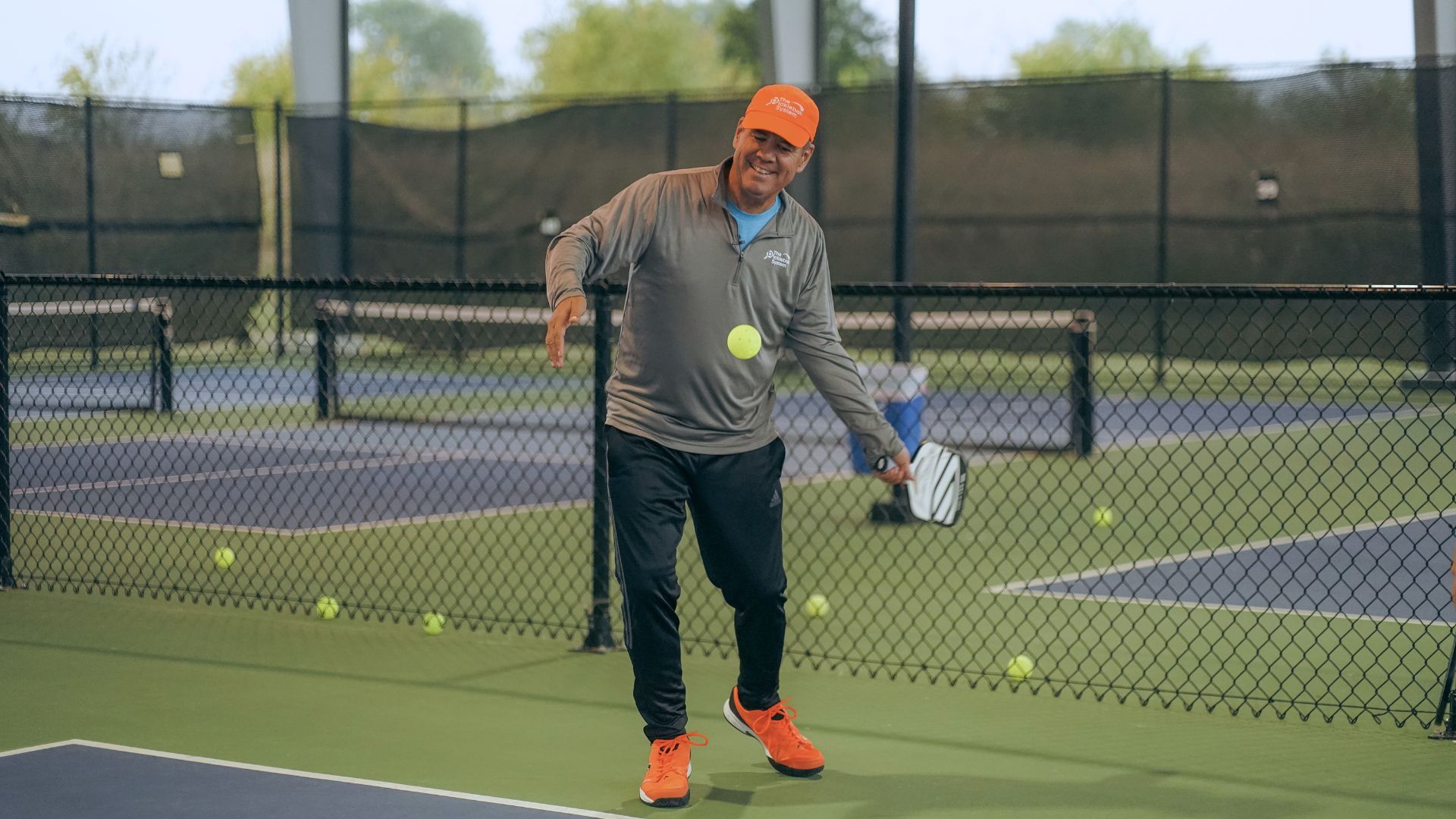
It is common for pickleball players to work on developing spin serves, particularly topspin.
If this sounds like you, or if this is something you have been thinking about pursuing, then this article is for you. Also, if you just want to understand how spins work in general read on.
What is Spin?
Spin is exactly as simple as it sounds: the ball rotates along an axis as it travels forward (translates) through space. Topspin is when the ball spins top over top away from you if you hit the shot or toward you if your opponent hit it. Underspin (or slice) is the opposite: the underside of the ball keeps spinning “away” from you if you hit the shot and toward you if your opponent hit it.
You can also side spin the ball, though this is rarer. Side spin means the ball is rotating left or right.
Spin affects the trajectory of the shot in flight and also influences what the ball will do when it bounces on the court.
A topspin shot will tend to dip sooner in flight than a flat shot (one with no spin) and will also bounce off the court with more energy sending the ball deeper off the bounce.
An underspin shot will tend to float as it travels through the air. When it bounces, the underspin shot will hitch (or brake) and not travel as deep as you might expect otherwise.
A sidespin shot will travel in the direction of its rotation: left will go left and right will go right. When the ball bounces, the ball will keep going in that same direction.
If you take a moment to think about how the ball is spinning in each of these spins, the in-air and after-bounce effects will make sense.
How is Spin Imparted?
I would venture to guess that when the majority of players think of imparting topspin to the ball, they are picturing the paddle “brushing” up on the ball. The image is of a paddle being quickly brought up along the back side of the ball forcing it to spin top over top for topspin.
While that image is not wrong, it is not the only way the paddle imparts topspin to the ball.
Whenever you bring your paddle under the ball and then swing up through the ball, you impart topspin to the ball. This is NOT a brush up. This is the paddle moving forward through contact with the ball.
Take it in parts. The paddle contacts the ball along its bottom-back quarter. The paddle then pushes through the ball, from the bottom-back quarter through the top-front quarter.
As the paddle pushes through the ball, the bottom-back quarter is forced up and over toward the top-front quarter, effectively delivering topspin into the ball as it is sent on its way.
Does your Serve Have a Natural Topspin?
The swing mechanic I described above – paddle coming under the ball and swinging up and through it – is the exact mechanic of the serve. In fact, the rules of the game require this sort of swing on your serve: making contact under your waist with an upward paddle arc.
So the answer to the question “does my serve already have topspin?” is yes. The only caveat here is that this applies to forehand serves. A backhand serve can be under or sidespun and still comply with the rules. This is because even though the paddle is moving on an upward arc the paddle is also brushing along the bottom of the ball causing it to spin opposite the topspin.
To be clear, there is a certain amount of ball brushing when you use a forehand serve swing. But the ball brush takes a backseat to the simple act of pushing the back-bottom of the ball up, making it tumble over itself in a topspin rotation.
If you are not sure about your serve already having spin to it, ask yourself this question: “when you serve are the ball’s holes static (motionless) or do they show ball rotation?” In my years of coaching, I have yet to see a regularly hit serve travel where I could clearly see the ball’s holes because the ball was traveling forward without rotation.
If your serve already has a natural topspin to it, then why do you hear that you need to add topspin to your serve?
There are three possibilities:
- The content creator is looking for clicks and topspin anything gets views.
- The creator does not understand that the regular serve already has topspin in it.
- The creator believes that you need even more spin.
The first two do not require a response. The third, what we refer to as “extra” spin, merits discussion.
Extra Note: If you pay attention to the pro game, you may have seen that Anna Leigh Waters added a super spinny high serve to her serve repertoire. Why should you not do the same? 1. It is easy for her to do that – she already has the tools to hit it. 2. Even though she added it, she only uses it sporadically – it is not her go to serve.
Coaching Tip: Resist the temptation to follow every shot or strategy you see the pros use. Studying strategies that the pros are adding to the game as it continues to evolve is one thing. Trying to do something just because the pros are is a whole different thing.
What’s Wrong with Adding Extra Spin?
There is technically nothing wrong with learning how to super spin the ball. But at what cost?
First, there is the distraction from other parts of the game that likely give you greater bang for your buck. When was the last time you practiced your volleys – block and punch? Or your footwork?
Second, a severe brush up on the ball is likely to result in increased errors. Shot reliability is determined at the moment when your paddle intersects the ball.
When you swing your paddle along the same line as the ball – and ultimate shot trajectory you are trying to achieve – you increase the chance that your paddle will intersect the ball correctly. When you swing your paddle across the shot trajectory – which is what you do when you brush up on the ball – you decrease the chance that your paddle will intersect the ball correctly.
Third, you can lose some power in your shot. We do not coach our students to hit a really hard serve. But we do coach our students to use their serve offensively by pushing the returner back.
Brushing up on the ball sends your paddle’s energy upward. The forward energy you put into the ball is indirect: it is from the ball bouncing off the paddle plus indirect angular energy into the ball from the swing.
Compare that to a swing that “drives” the paddle through the ball. In this swing, your paddle’s energy is going directly into the ball along its intended trajectory.
Conclusion
While there is nothing technically wrong with adding “extra” topspin to your serve, there is likely not a reason to chase this shot modification. Keep relying on the topspin you are already generating and focus your efforts into more productive areas of the game.
Be well.