Too Many Voices? Why You Can't Hear Any of Them
Oct 02, 2026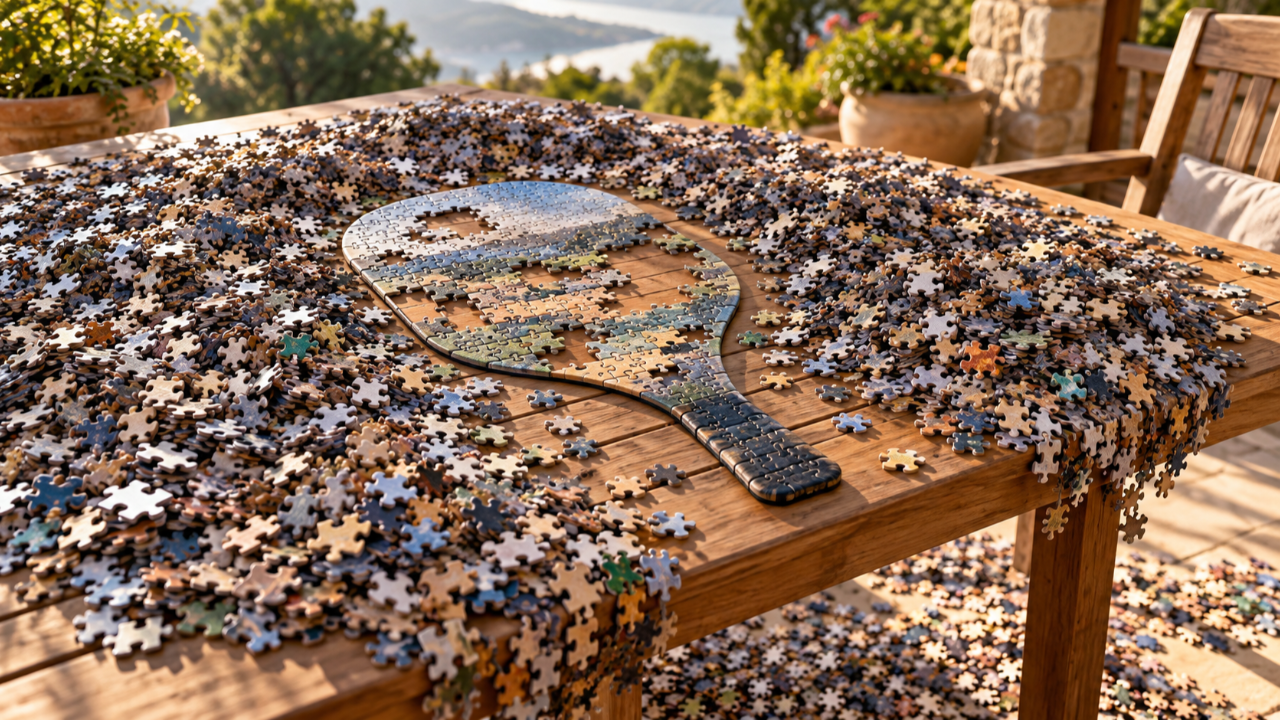
How much of what you know about pickleball do you really understand?
In Episode 315 of Pickleball Therapy, Coach Tony borrows a term that captures this kind of surface-level understanding. He calls it "Google knowledge." It describes knowledge that doesn't go very deep. You've seen a video. You've read a post. Someone at the courts passed along a tip. Now you have a collection of whats. You don't yet understand the why.
There's nothing wrong with that. It's how most learning journeys start. The problem is that Google knowledge can feel like real knowledge. That's what makes it both sticky and tricky.
How Google knowledge shows up on the court
On the podcast, Tony uses middle coverage as the example. Plenty of players will tell you the rule is that the forehand takes the middle. On the surface, it sounds pretty good. Plus, it's easy to remember. The forehand is assumed to be the stronger wing. So the forehand takes the shot. Done.
But wait... Go one layer deeper. What about a right-handed player on the right side whose backhand is stronger than their forehand? Stronger, even, than their partner's forehand? That's not unusual in pickleball. Or what if a doubles team consists of a righty and a lefty? Now there may be two forehands in the middle. Or there may be none. Suddenly "forehand takes the middle" is a strategy that leads to more questions than answers.
The point isn't this one middle ball coverage example. The point is depth of understanding. Google knowledge stops at "sounds right." Real knowledge asks "why?" and keeps asking "why?" until the pieces fit together.
That's why Coach Tony's coaching works for me. It's always about the why. When you understand the rationale, you can stop collecting rules and "maxims" (or are they myths?) that can't survive a stress test. Instead, you start to see how the game is built. The more you understand how the game is built, the more you'll see its beauty, and the more fulfilling it'll become.
The cost of letting everything in
The road from Google knowledge to real knowledge is rockier when you're buried in information.
Think about what comes at you in a given week. Newsletters. Videos. Shorts. Every tip your friends picked up. This blog post. Each piece is likely to be offered in good faith. Combined, they get awfully noisy. As Tony puts it, too many voices, and you can't hear any of them.
He points to an old episode of The Twilight Zone about a man who read everything. Newspapers, books, whatever he could get his hands on. Whether the writing was good or bad or relevant or irrelevant wasn't important. He wasn't reading to learn. He was reading just to pass the time. Reading for the sake of reading isn't fundamentally bad. But if you want what you read (or watch or listen to) to change your life, you must learn to discern what matters from what doesn't.
Pickleball information works the same way. Without discernment, the useful stuff gets lost in the pile. That costs you in at least two ways: (1) You struggle to put the relevant bits together; (2) The game becomes more stressful. It's like trying to put together a thousand-piece jigsaw puzzle, but being handed 10,000 pieces and no puzzle box top.
How to choose what to let in
Long term, the goal is real knowledge. The more real knowledge you gain, the easier it is to filter and assimilate into your game. You'll see a tip and know its value right away. "That one fits my game. That one doesn't."
In the short term, you won't have an efficient filter. So you'll need to trust someone. Find a coach whose approach to pickleball and learning makes sense to you. Commit to that person's teaching while you build your understanding of the game. Then reduce the noise by cutting back on everything else.
Consider this: Over the next week or so, remove one source of pickleball input. Unsubscribe from one email list. Unfollow one channel. Or scroll past the videos you'd normally watch. Notice what happens. With less coming in, you have more space to process what you choose to keep. That's where real knowledge starts to build. And if that means unfollowing us, we'll be sad, but we'll survive. We hope you'll come back. When you're ready, we'll be here.
Choose a trustworthy voice. Let the rest go. Go deep. Build real knowledge.
See you on the pickleball court,
Jeff
P.S. For me, the fastest move from Google knowledge to real knowledge happened at Tony Roig pickleball camps. If you're curious, here's where you can learn more about the TRP camp experience and see what camps are coming up: https://www.tonyroigpickleball.com/camps
Jeff Renshaw is a PPR-certified coach and part of the Tony Roig Pickleball team.