Potential causes of elbow/forearm pain from playing pickleball
Aug 06, 2026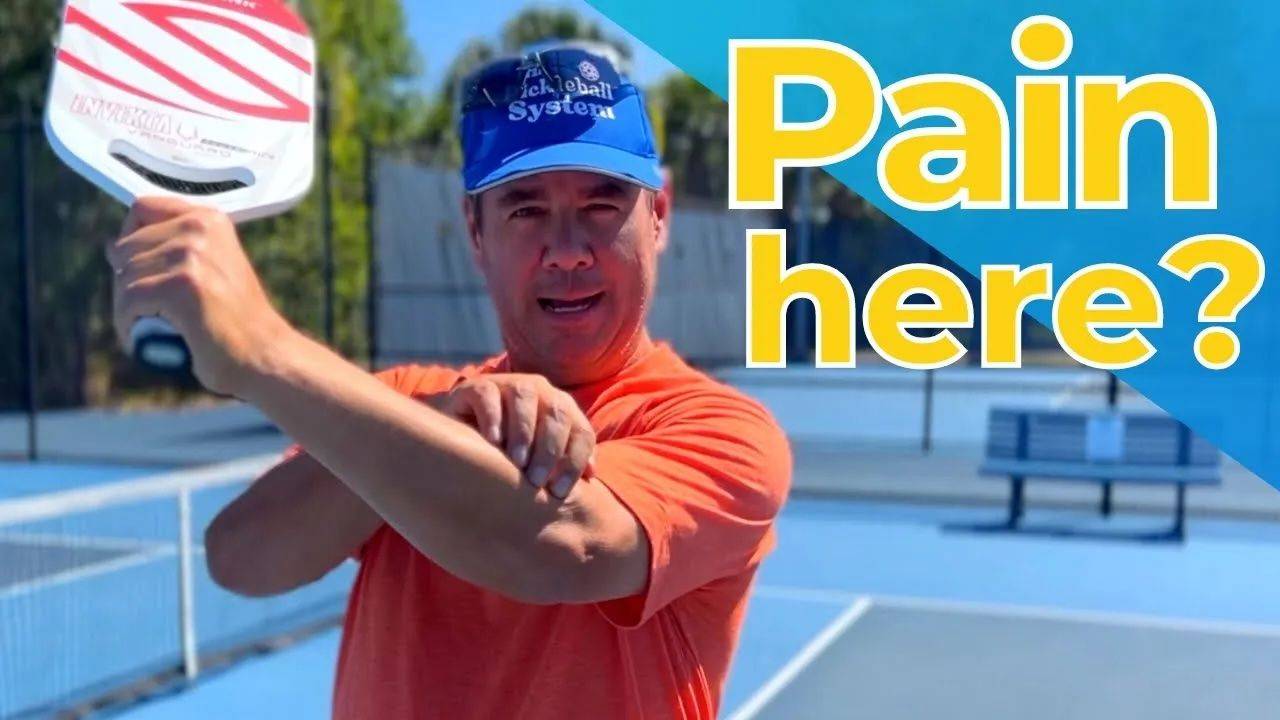
Perhaps the most common injury in pickleball is a strain in a player’s forearm or elbow. Below we tackle several of the most common causes of pickleball player arm pain and provide suggestions to reduce their impact.
NOTE: Nothing in this article is intended to diagnose your specific condition. This is not medical or health care advice. This article is informational only. If you are experiencing arm pain or injury, please consult a medical professional.
The forearm
Your forearm muscles are small, representing around 2% of your total body mass. Yet these are the muscles we call on repeatedly to swing our paddle in a fairly violent manner for 2-3 hours, 3-4 times a week (sometimes more).
So it’s not surprising that this small group of muscles and associated tendons can become overused, strained, or worse yet, damaged through pickleball.
Setting the scale of the muscle group allows us to see how “small” things can add up quickly and result in potential pain.
Let’s explore some areas that can contribute to, or be the root cause of, pain in the forearm/elbow. From here on out, I will refer to the pain as “arm pain.” The causes discussed below can affect the elbow, forearm, hand, and sometimes even the shoulder.
Flawed mechanics
Let’s say every time you hit a backhand, you flip the paddle up and over with your wrist. Try it now without your paddle. Put your dominant hand out, bend your hand downward, then – gently – extend your hand the other way (palm facing outward with fingers pointed toward the sky). Like this: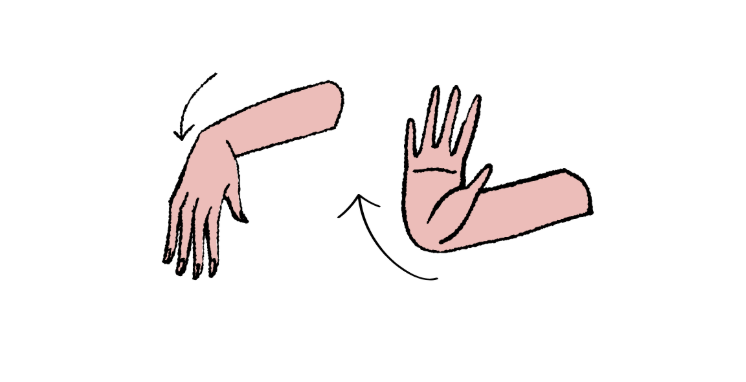
Imagine doing that motion, with force, 100+ times in a pickleball session. That would certainly be stressful on your wrist and forearm, no?
You may not have this specific wrist-flick mechanic, but it illustrates how repeatedly moving our paddle in a certain way can strain our arm.
So the question to ask yourself is, “Am I swinging the paddle in a way that might be creating unnecessary strain on my arm?” If the answer is “yes,” then consider adjusting your swing mechanics to simplify the stroke. Often, you will find that doing so will not only eliminate some of the extra strain, but also make your shots more reliable.
You can check your swing mechanics by videoing yourself. You can also work with a coach or personal trainer to check how the mechanics of your swing might be affecting your arm.
“Death” grip
If you’re gripping your paddle like your life depends on it, you’re probably placing unnecessary strain on your arm. And if you’re death gripping the paddle for 2-3 hours multiple times a week, you’re likely wearing your arm out.
The solution is to lighten your grip. Here’s how:
- Grip your paddle as hard as you can (without hurting yourself) – this is a 10 on the grip pressure scale.
- Half your grip pressure – this is a 5 on the scale.
- Half it again – we’ll call this a 3.
Play the game with a 3 grip pressure—the whole game. Not only will your arm thank you for it – so will your game, because you’ll play better.
Improper grip size
A grip size that is too big or too small can also exacerbate your arm pain. You can test it yourself:
- Grip a water bottle in your hand as if it were your paddle. Feel the tension in your arm as you try to keep the bottle gripped. That grip is obviously too big for you.
- Next, grip a pencil or pen and imagine trying to hold that while you play pickleball. That grip is too small.
A quick way to check your grip size is to grip the paddle and then try to fit your other hand’s pointer finger in the space between your palm and fingers. It should snugly fit.
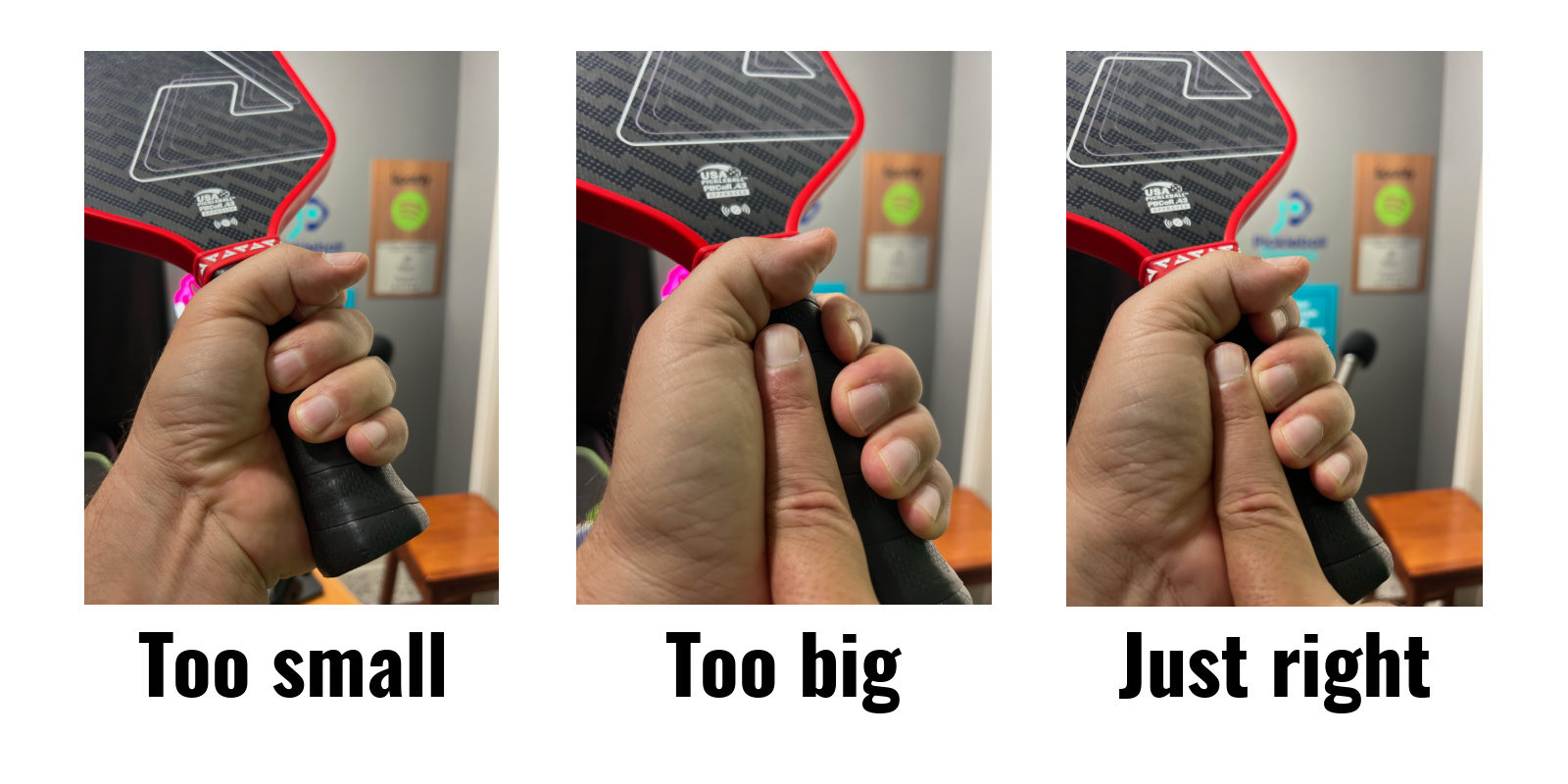 If your grip size is too big, consider removing the stock grip that came with the paddle and then applying an overgrip (without the stock grip). You will lose the cushioning from the stock grip, but it’s better to have the right size.
Note that thick paddles (e.g. 16mm) unavoidably have larger grips due to the width of the paddle itself.
If your grip is too small, you can layer overgrips on it to make it larger. You can also consider an aftermarket grip modified, like the Hesacore. I have used these with success.
Paddle too heavy
A paddle that is too heavy for you will create extra tension in your arm as you swing the paddle around. Note that we are referring to swing weight – not gross (or scale) weight. Swing weight is how the paddle feels when you swing it – which is not the same as gross weight.
Nowadays there is much more paddle data, including swing weight. I have used this spreadsheet successfully in the past.
From my pov, a swing weight under 105 is light. The most recent paddles I have played with have been 105 and now 114, and I have found these to be well balanced – swinging neither too lightly nor too heavily.
If you are having arm pain, check your paddle’s swing weight. The smaller you are, the lighter you will want to go. You can always add weight to a paddle using edge weights. But you cannot remove weight from the paddle.
Overuse
This one should be fairly self-evident. If you are playing 15 hours a week, you may need to give your arm a rest from time to time. If you want to beef your arm up to withstand 15 hours a week, then strengthen it. More on that in a moment.
Strength
It cannot come as a surprise that stronger muscles will be more resilient and able to take the beating that constant pickleball can put on them. You can reduce the chance of injury and extend your on-court time by putting in some off-court work.
There are plenty of content creators out there who specialize in body workouts. You are looking for exercises to strengthen your arm, specifically the forearm and the area around the elbow.
This type of work is what we refer to in our coaching as the Athletic Pillar (your body and mind). It is part of the Three Pillars of Pickleball – all of which you need to play your best (and live your best, too).
If you are suffering through arm pain, I wish you a speedy recovery. And if you are not – and want to avoid it – then get started now on strengthening your arm and checking the other factors listed above to make sure they don’t get in the way of your enjoyment of this amazing sport.
Be well
Tony